The tortoise practice
The Bhagavad Gita gives this limb its lasting image: “One who is able to withdraw his senses from sense objects, as the tortoise draws its limbs within the shell, is firmly fixed in perfect consciousness” (Gita 2.58). The practice below draws the limbs in one at a time.
- Sit or lie comfortably where we will be undisturbed. Let the breath settle into a slow, even rhythm; a few minutes of pranayama prepares this ground well.
- Close the eyes. Sight is the first limb drawn in. Notice how much attention returns the moment the eyes stop reaching.
- Listen to the sounds around us. Name none of them. Let each one arrive and pass like weather, until hearing rests without grasping.
- Feel the points of contact: the seat, the hands, the air on the skin. Acknowledge each sensation, then release the attention that holds it.
- Notice smell and taste, the quietest senses, and let them go last. What remains is awareness resting in its own field, senses present and unentangled.
- Rest there for a few minutes. When the mind reaches outward again, and it will, draw the limb back in gently. The returning is the practice.
Withdrawal is a soft word here. The senses keep working; the tortoise keeps its limbs. What changes is the entanglement: attention stops running out along each sense to grip its object. Systematic relaxation, yoga nidra, and savasana at the end of an asana practice all train the same release.
The image is older still. The Katha Upanishad (I.3.3–9, trans. Easwaran) gives the discipline its classic form as a chariot, in its own words: “Know the Self as lord of the chariot, The body as the chariot itself, The discriminating intellect as The charioteer, and the mind as reins.” It goes on: “The senses, say the wise, are the horses; Selfish desires are the roads they travel.” When the mind is undisciplined the horses “Run hither and thither like wild horses,” but with discrimination and a one-pointed mind they “obey the rein like trained horses.” The same Upanishad (II.1.1) states the move plainly, that “A sage withdrew his senses from the world” and “Looked within and beheld the deathless Self.”
My own reading of this is deliberately plain. Pratyahara is not the shutting-off of the senses but the taking up of the reins. The horses are never unhitched and are not the enemy; the work is to hold them, so that attention goes where it is directed rather than bolting after whatever pulls hardest. Read this way the practice asks no belief at all: it is a discipline of self-mastery, and where the chariot is driven is left to the one who drives.
There are many ways to read the chariot, and this page keeps them side by side rather than settling them. Easwaran ends the passage devotionally, the well-driven horses reaching “the supreme goal of life, To be united with the Lord of Love,” a theistic destination. Taken without that frame, the same verse is a purely psychological map of self-command with no deity in it. And the image is not India’s alone: the editor Michael Nagler notes it recurs in the Bhagavad Gita, where Krishna drives as Arjuna’s charioteer, and that “Plato also used it, less elaborated, in the Phaedrus.” The same reins, held toward different ends, which is why the picture has lasted across so many traditions.
Where the outer practice turns inward
Patanjali gives pratyahara two sutras, and they are hinges for the whole eight-limbed path. “The disengaging of the powers from entanglement in outer things” is how Charles Johnston renders Yoga Sutra II.54, and II.55 completes the thought: “Thereupon follows perfect mastery over the powers.” The first four limbs work on the visible life: ethics, discipline, posture, breath. At pratyahara the practice crosses a threshold and disappears from view. In a comparative study of the Patanjali sources, Randika Perera describes the same crossing: the practice of pratyahara “makes the individual absent from the external sensory experience and leads the individual consciousness into an internal state,” which he calls “the opening door to enter the experience of the deeper consciousness.”
The Gheranda Samhita, which arranges its hatha yoga in seven limbs rather than eight, actually places pratyahara earlier than Patanjali does, before its pranayama rather than after, counting it the fourth means, the one that brings calmness. So the two systems differ on where breath and sense-withdrawal fall relative to each other. What they agree on is the deeper order: sense-withdrawal comes before the gathering of the mind, because a mind still wired to every sound and itch has nothing left over to concentrate with.
In a 2024 survey of 37 yoga teachers in Delhi, every limb was reported as part of their practice, but the emphasis fell unevenly: pranayama (91.9%) and asana (89.2%) led, while pratyahara (70.3%) sat among the least emphasized limbs. The thinness of this limb in modern teaching is measurable, and it is exactly the gap this page is for.
Roots, ground, branches, and the world beyond
There is a meditation almost every practitioner meets sooner or later. We sit, and we imagine roots growing down from the base of the seat, threading into the earth, anchoring us. Then we imagine light rising up the spine and pouring out through the crown of the head, a column of brightness opening into the sky. In that single image, the whole map is drawn. Once the senses turn inward, the practice reaches in both directions at once: down into what is hidden, up into what is vast.
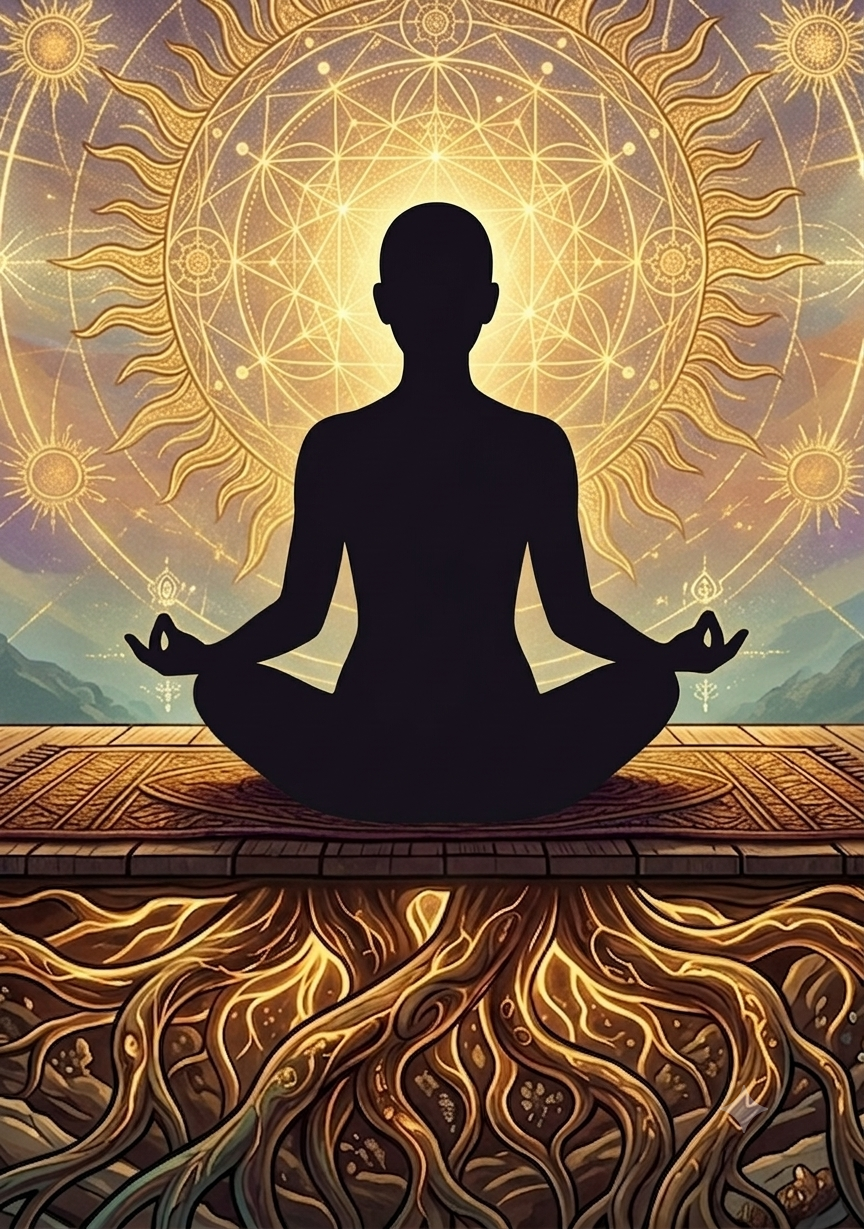
The crown opens and the practice expands past the personal entirely, into the absolute realm where nothing is relative. This is the reach of samadhi and sat-chit-ananda.
Above the dense body lie the subtle and causal sheaths, the symbolic, energetic, dreaming layers the tradition calls the koshas, the five sheaths first set out in the Taittiriya Upanishad, and the realms it calls lokas. Meditation as the discovery of worlds.
The seat, the bones, the breath, the present moment. Meditation is also the discovery of this world, seen at last without the haze of distraction. The ground is where the practice finally arrives.
Roots descend from the seat into the dark and sustaining depths: memory, instinct, the buried patterns that move us before we choose. To meet them in stillness is the beginning of freedom from them.
Notice that the same practice does two opposite things. It is a discovery of other worlds, the subtle planes the tradition names akasha and the lokas, what later esoteric traditions called the astral. And it is a discovery of this world, the one already here, the breath and the body and the ordinary afternoon, which we have simply never been still enough to see. The mystic who travels furthest inward and the practitioner who arrives most fully in the present are describing the same journey from two ends.
And here the cosmic image returns. The roots reaching down and the light reaching up are only a beginner’s compass, a way to orient a mind that still believes in up and down. The further the practice goes, the more those directions dissolve, until what remains is an expansion outward in every direction, the seated body a still point and the awareness around it opening like space without limit. The map is a tree. The territory is a universe.
The reaches are traveled by the practices of meditation, and their furthest edge, the world beyond, has its own page: Samadhi, the alchemy of absorption →
Interoception: what science can see of the inward turn
Sense-withdrawal has no laboratory instrument, but its nearest measurable neighbor does. Interoception is the perception of the body from within: the heartbeat, the breath, the gut, the felt sense of being a body at all. The neuroscientist A.D. Craig defined it as the sense of the physiological condition of the entire body, not the viscera alone, re-represented in the brain as the ground of how one feels. When attention stops running outward along the five senses, what it meets first is this inner field, and interoception is where contemplative science has learned to look.
The field's consensus roadmap (Khalsa et al. 2018) maps interoception across psychiatric conditions and names it a basic dimension of mental health. A multi-author review (Farb et al. 2015) draws the explicit bridge to contemplative practice: attending inward is trainable, and the training matters for health. Somatic-movement educators reached a parallel conclusion from the studio rather than the laboratory: Thomas Hanna defined the somatic as the body perceived from within, and traditions like the Alexander and Feldenkrais methods treat that inner self-sensing as a fallible skill of attention, one that is often unreliable and can be re-educated (Lynn 2017; Fraleigh 2015). The standard measure is a questionnaire, the MAIA (now MAIA-2), which breaks “interoceptive awareness” into scales like noticing, not-distracting, and trusting, close cousins of what pratyahara cultivates. The somatic educators complicate that last scale rather than confirm it. In the Alexander tradition the felt sense is treated as unreliable rather than authoritative, so unfamiliar inner sensations are to be noticed but not trusted until the sensing itself is re-educated (Lynn 2017). Their inner field is also chiefly the proprioceptive one, the sense of balance, joint position, and felt movement (Lynn 2017; Fraleigh 2015), which overlaps with but is not identical to the visceral interoception, the heartbeat and the gut, that the laboratory measures.
The evidence is honest rather than tidy. It helps first to name what is being measured, since interoception is not one thing. A review by Critchley and Garfinkel (2017) sorts it into three dissociable dimensions: the objective accuracy of a task such as counting one's own heartbeats, the subjective sensibility a person reports on a questionnaire like the MAIA, and the metacognitive awareness that measures the fit between the two. These were shown to move independently of one another, which is why a practice can lift one without touching the others. A 2025 meta-analysis of 29 randomized trials found that meditation training reliably improves self-reported interoception, that middle dimension of sensibility. A large trial from outside the meditation world points the same way: adding body-oriented interoceptive-awareness training to medication for opioid use disorder produced a year-long gain in self-reported interoception (a modest effect on the MAIA in more than three hundred people), while it changed neither the objective measures nor the primary substance-use outcomes (Price et al. 2025). A 2023 yoga study is the counterweight: ten weeks of practice moved no objective measure of cardiac or gastric accuracy. Read together, the research suggests that practice changes the relationship to inner sensation, how it is noticed, trusted, and met, more readily than it sharpens detection itself. The tradition would recognize that distinction: pratyahara cultivates freedom from the pull of what is sensed, and it promised sharper hearing to no one.